 Moving on a Budget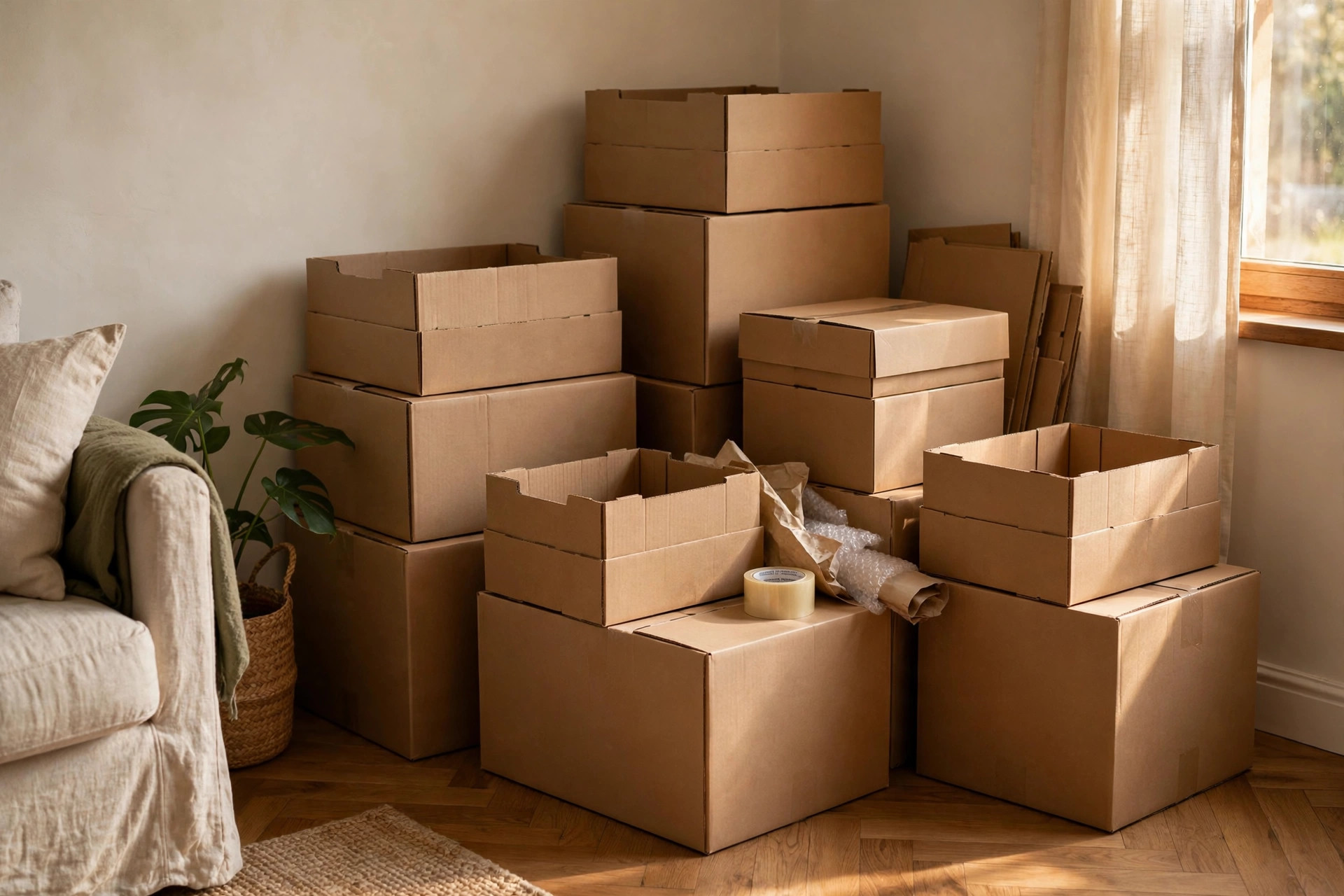
Packing Like a Pro Without Buying Supplies
Professional packers don't have better boxes than you — they have better habits. The boxes themselves can be free.
Moving-supply stores will happily sell you a full kit for a one-bedroom at a price that makes your eyes water. Almost none of it is necessary. Boxes, cushioning, and tape are commodities, and free versions of all three are within a few days of asking. Here's the whole system.
Free boxes that actually hold up
Not all free boxes are worth carrying home. The goal is clean, dry, single-use boxes — ideally from shipments, not from storage rooms where they've been damp and weakened.
- Grocery stores — produce boxes and banana boxes are the gold standard: small, sturdy, with handles. Ask the produce manager when their delivery days are and come that morning.
- Liquor stores — small, thick-walled boxes with dividers, perfect for glasses and fragile items. They break them down fast, so ask and take them same-day.
- Bookstores and offices — paper-box boxes (the ones reams of paper ship in) are strong, lidded, and uniformly sized, which stacks beautifully in a truck.
- Appliance and electronics stores — big boxes for lamps, monitors, and awkward items. Ask for the original box of anything you bought there if you need an exact fit.
- Online listings — people give away moving boxes constantly after their own moves. Search free listings a week or two before you need them; a full matched set of used moving boxes is the jackpot.
- Your own deliveries — start saving shipping boxes the moment you decide to move. A month of online orders is a meaningful head start.
Tip: Skip boxes that are soft, stained, or smell like anything. A crushed box is worse than no box — it teaches you nothing until it fails in the truck. Reject aggressively; free boxes are abundant.
What to use instead of bubble wrap
Bubble wrap is the most overpriced item in the moving aisle. Your home is already full of better cushioning:
- Towels, linens, and blankets — wrap dishes in dish towels, nest glasses in socks, pad box tops with bath towels. It all has to move anyway.
- Clothing — t-shirts and sweaters are excellent padding for fragile items, and vacuum-sealed bags (if you own them) compress winter coats into gap-fillers.
- Newspapers and flyers — crumpled newsprint is the classic free void-fill. Use plain paper against anything light-colored to avoid ink transfer.
- Grocery bags — plastic bags stuffed into gaps stop items shifting, which is what actually breaks things.
- Pillows and stuffed animals — box toppers and gap-fillers with zero extra weight.
The professional principle is simple: fill every void. Things break because they move inside the box, not because the box is weak. A tightly packed free box beats a loosely packed expensive one.
The two things worth buying
Nearly everything can be free except two items:
- Packing tape (good quality). Cheap tape splits, loses adhesion in heat, and needs three strips where good tape needs one. Buy the decent kind from a hardware store — it's the cheapest insurance in the move.
- Stretch wrap. A roll of cling-style stretch wrap keeps dresser drawers shut, bundles awkward items, and protects upholstery. One roll goes a long way.
That's the entire shopping list. Mattress bags are the honorable mention — a cheap one protects a mattress worth far more, and a clean fitted sheet works in a pinch.
Packing habits that prevent damage
- Heavy items in small boxes, light items in big boxes. The most common beginner mistake is one giant box of books that nobody can lift and everyone drops.
- Label every box on two sides: room + a one-line contents note ("Kitchen — pots and pans"). Number boxes and keep a one-page master list of the important ones.
- Pack one room at a time and finish it. Half-packed rooms create chaos on moving day when everything needs to be sealed at once.
- Photograph electronics and furniture assembly before disconnecting or disassembling. The photo is free; the "where does this cable go" hour is not.
- Bag screws and small parts in labeled zip bags and tape them to the furniture they belong to.
- Keep boxes under about 50 pounds (23 kg). Your back, your helpers, and your floors will thank you.
Start early — packing is the schedule-killer
Packing always takes longer than expected, and last-minute packing is what forces expensive decisions: buying supplies at retail, paying movers to pack, or throwing unsorted chaos into garbage bags. Start three to four weeks out with the rooms you use least, and aim to be fully packed the night before moving day. The move itself is stressful enough; don't pack during it.
The frugal packer's rule: if you're buying it at a moving-supply store, ask first whether something you already own does the job. Nine times out of ten, it does — and the tenth time costs less than the kit they tried to sell you.